Unguarded at Scale: The DDoS Vulnerabilities Exposing Mid-Market US Businesses Right Now
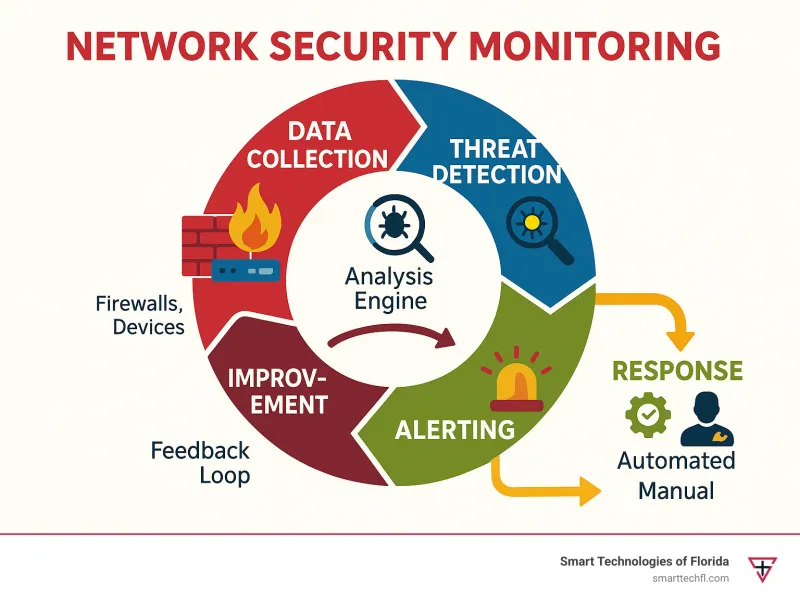
Photo: cybersecurity network traffic monitoring firewall protection, via images.bannerbear.com
Distributed denial-of-service attacks are not a new category of threat. What has changed substantially in recent years is the targeting calculus that attackers apply. Enterprise organizations — Fortune 500 companies, major financial institutions, federal agencies — have invested heavily in mitigation infrastructure, scrubbing centers, and dedicated security operations teams. The return on investment for attacking these targets has declined. Mid-market businesses, typically defined as companies generating between $10 million and $1 billion in annual revenue, have become the more attractive opportunity.
These organizations are large enough to depend critically on web availability for revenue generation, yet they frequently lack the security investment that would make an attack operationally difficult. The result is a category of businesses that presents meaningful financial leverage to attackers while offering substantially less resistance than enterprise targets. Understanding how attackers identify and exploit these vulnerabilities is the first step toward closing them.
How Attackers Profile Mid-Market Infrastructure
Before launching a volumetric or application-layer attack, sophisticated threat actors conduct reconnaissance. This process is more systematic than many security teams appreciate. Publicly available tools can identify the hosting provider, CDN configuration, and origin IP address for a given domain within minutes. Rate-limiting rules can be probed passively by examining response headers and error codes returned under varying request frequencies. Web application firewall signatures can be fingerprinted through the specific error messages they generate.
For mid-market businesses, this reconnaissance phase frequently reveals several exploitable conditions. Rate-limiting thresholds are often set conservatively to avoid impacting legitimate traffic spikes during promotional events, leaving substantial headroom for malicious volume. WAF rule sets are commonly deployed using vendor-default configurations rather than tuned baselines derived from actual traffic patterns. Origin infrastructure — the servers that sit behind CDN and load-balancing layers — may be discoverable through historical DNS records or misconfigured email headers, allowing attackers to bypass mitigation layers entirely.
A Case Study in Infrastructure Collapse
Consider the experience of a regional US e-commerce retailer — a business with approximately $80 million in annual revenue, a competent internal IT team, and what leadership believed to be adequate hosting infrastructure. During the week preceding a major promotional sale, the company experienced a sustained application-layer DDoS attack targeting its product search and checkout endpoints.
The attack did not generate traffic volumes that would have overwhelmed the company's bandwidth capacity. Instead, it sent carefully constructed HTTP requests that appeared superficially legitimate but were designed to trigger expensive database queries on each request. Each individual request was indistinguishable from legitimate user behavior at the network layer. The company's rate-limiting rules, set to block IP addresses generating more than 500 requests per minute, were not triggered because the attack distributed its requests across thousands of source addresses, each generating far fewer than the threshold.
Within forty minutes, database connection pools were exhausted. The application began returning errors to all users — including genuine customers. The company's CDN provider detected the anomaly, but the WAF rule set lacked the application-aware logic required to identify the attack pattern. By the time the team had manually identified the attack signature and deployed a mitigation rule, the promotional sale window had suffered nearly three hours of degraded availability. Revenue impact was estimated at several hundred thousand dollars.
The attack was not sophisticated by enterprise security standards. It was, however, precisely calibrated to the gaps in this company's specific configuration.
The Configuration Gaps That Enable These Attacks
Three technical deficiencies appear consistently in mid-market DDoS post-mortems.
Static rate-limiting rules. Rate limits defined by a fixed requests-per-IP threshold are effective against unsophisticated attacks. Modern distributed attacks operate below those thresholds by design. Effective rate limiting requires behavioral baselines — understanding what normal traffic patterns look like for specific endpoints and flagging deviations, not just absolute volumes.
Default WAF configurations. Web application firewalls are powerful tools when properly tuned. Deployed with vendor defaults, they provide meaningful but incomplete protection. Rules must be calibrated to the specific application — its URL structure, expected parameter ranges, and normal user session behavior. A WAF that has never been tuned to the application it protects will generate both false positives that block legitimate users and false negatives that permit malicious traffic.
Unmonitored origin exposure. If the origin IP address behind a CDN or DDoS mitigation service is discoverable, the entire mitigation layer can be bypassed. Mid-market businesses frequently fail to audit origin exposure after infrastructure changes, CDN migrations, or email configuration updates — all of which can inadvertently reveal origin addresses.
A Practical Security Audit Checklist
The following framework is designed to be actionable within the resource constraints typical of mid-market IT teams.
Audit your origin exposure. Use historical DNS lookup services and email header analysis tools to determine whether your origin IP addresses are discoverable. If they are, rotate them and implement strict firewall rules that accept traffic only from your CDN or mitigation provider's published IP ranges.
Establish traffic baselines. Instrument your infrastructure to capture normal request volume, session duration, and endpoint usage patterns segmented by time of day and day of week. These baselines are the foundation for behavioral anomaly detection.
Review and tune WAF rules quarterly. Schedule regular reviews of WAF logs to identify patterns in blocked and permitted traffic. Engage your hosting or security provider to validate that rule sets reflect your application's actual behavior rather than generic defaults.
Implement endpoint-specific rate limiting. Apply distinct rate-limiting policies to high-value, computationally expensive endpoints — search functions, authentication pages, checkout flows — rather than applying uniform thresholds across all traffic.
Conduct tabletop exercises. Simulate an attack scenario with your team at least twice annually. Identify who is responsible for each mitigation step, confirm that escalation paths are current, and document the expected time-to-mitigation for common attack patterns.
Defense as an Operational Practice
DDoS resilience is not a product that can be purchased and forgotten. It is the outcome of ongoing operational discipline — regular audits, tuned configurations, and a team that understands how its specific infrastructure would be targeted. Mid-market businesses that treat security as a one-time configuration exercise will continue to present attractive, exploitable targets.
The infrastructure services available through 1-WS.com are designed to support this kind of continuous, operationally grounded security posture. Effective protection begins not with the most expensive tooling, but with an honest assessment of where your current configuration leaves you exposed.