The Data Integrity Threat Hiding in Plain Sight: Silent Database Replication Failures Explained
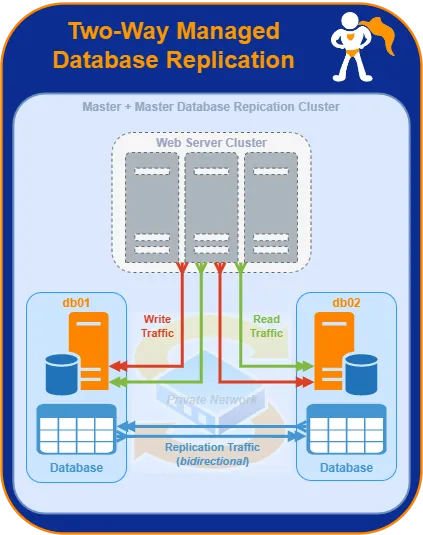
Photo: database server replication data integrity monitoring technology, via blogcdn.namehero.com
A Failure Mode That Looks Like Success
Of all the infrastructure risks that SaaS operators and e-commerce businesses face, few are as insidious as a silent database replication failure. Unlike a server outage or a failed deployment, a broken replication chain does not announce itself. Applications continue to serve requests. Users log in, place orders, update records. From every external vantage point, the system appears fully operational.
Internally, however, the replica databases that are supposed to mirror the primary instance have begun to diverge. The gap widens slowly—hours, then days, then weeks. By the time the inconsistency is discovered, the business is confronting a data integrity problem that may be impossible to fully remediate.
This scenario is not hypothetical. It is a documented failure pattern that affects organizations across the United States, from early-stage SaaS startups to established e-commerce platforms processing millions of transactions annually. The common thread is not a lack of technical sophistication—it is a monitoring approach that measures the wrong things.
Understanding Why Replication Breaks Quietly
Database replication, in its most common implementations, works by transmitting a log of changes from a primary database instance to one or more replica instances. When the system functions correctly, replicas remain synchronized with the primary within milliseconds. When it fails, the replication stream stops advancing while the primary continues to accept writes—and the divergence begins.
Several conditions can trigger this failure mode. Network interruptions between the primary and replica nodes can cause the replication stream to stall. Schema changes applied to the primary without corresponding updates to the replica can cause replication to halt when it encounters an unfamiliar table structure. Large transactions that exceed buffer thresholds can interrupt the log transmission process. In some database engines, a single problematic row—containing a data type the replica cannot process—is sufficient to stop replication entirely.
What makes these events dangerous is that many of them are self-contained. The error occurs, replication halts, and the system enters a stable but incorrect state. There is no cascading failure, no application crash, no user-facing error message. The replica simply stops reflecting reality, and the monitoring dashboard reports that all database instances are online and responsive—because they are.
Why Standard Monitoring Falls Short
Conventional database monitoring is designed to detect availability problems. It checks whether the database process is running, whether connections can be established, and whether query response times fall within acceptable thresholds. These are legitimate and important metrics, but they are structurally incapable of detecting replication drift.
A replica that stopped replicating six days ago will pass every availability check. It is online. It accepts connections. It responds to queries quickly—often more quickly than the primary, precisely because it is no longer processing an incoming replication stream. From the perspective of a standard health check, it is a healthy database node.
Replication lag monitoring addresses part of this gap, but introduces its own blind spots. Many teams configure alerts for replication lag exceeding a threshold—say, 30 seconds. This catches scenarios where replication is running slowly. It does not catch scenarios where replication has stopped entirely and the lag counter has simply frozen at the last reported value, or where the monitoring agent is reading from a stale cache.
Application-level behavior adds another layer of complexity. In architectures where read traffic is distributed across replicas to reduce load on the primary, users may be reading outdated data without any indication that something is wrong. An e-commerce customer checking their order history may see a status that is days out of date. A SaaS user reviewing account activity may be looking at a snapshot that predates their most recent changes. Neither user has a reason to report an error—they assume what they see is current.
The Consequences When Discovery Comes Late
The business impact of a prolonged replication failure scales directly with the duration of the divergence. A failure detected within hours is typically remediable by resynchronizing the replica from the primary. A failure that persists for weeks creates a more complex problem.
Consider a subscription billing platform where the replica database—used by the reporting system and the customer-facing billing history page—diverges from the primary for three weeks. During that period, subscription changes, payment records, and account modifications are written to the primary but not reflected in the replica. When the failure is discovered, the reporting data is materially inaccurate, customer billing histories are incomplete, and any decisions made on the basis of replica data during that window are potentially compromised.
For regulated industries, the implications extend beyond operational inconvenience. Inaccurate financial records, incomplete audit trails, and inconsistent data states can create compliance exposure that carries consequences well beyond the cost of the technical remediation itself.
Building an Early Detection Framework
Effective detection of replication failures requires monitoring that goes beyond availability checks and lag thresholds. The following framework reflects the approach that rigorous infrastructure operations teams have adopted to close this monitoring gap.
Implement replication position tracking. Rather than relying solely on lag metrics, monitor the binary log position or replication sequence number on both the primary and each replica. A replica whose log position has not advanced in a defined interval—regardless of what the lag counter reports—should trigger an immediate alert.
Deploy data consistency probes. At scheduled intervals, write a known value to a dedicated verification table on the primary and confirm that the value appears on each replica within an expected timeframe. This end-to-end test validates the entire replication path rather than relying on the database engine's self-reported status.
Audit replica error logs automatically. Replication failures typically generate error entries in the database engine's log. Automated log parsing that surfaces replication-specific error codes—rather than waiting for a human to review logs manually—dramatically reduces detection latency.
Separate monitoring infrastructure from application infrastructure. Monitoring agents that run on the same nodes they are observing can report false positives when the node itself is degraded. Independent monitoring infrastructure provides a more reliable signal.
Establish a replication health review cadence. Even with automated monitoring, a scheduled human review of replication health metrics—weekly at minimum—provides a check against scenarios where monitoring itself has degraded.
The Organizational Dimension
Technical solutions address the detection problem, but sustainable data integrity requires an organizational commitment to treating replication health as a first-class operational concern. Teams that have experienced silent replication failures typically describe the same pattern: replication was configured correctly at deployment, monitoring was assumed to be sufficient, and no one was explicitly responsible for verifying that the assumption remained valid over time.
Assigning clear ownership of replication health monitoring, incorporating replication status into routine operational reviews, and treating a replication failure as a severity-one incident regardless of immediate user impact—these are the practices that prevent a technical vulnerability from becoming a business crisis.
The infrastructure that supports your application is only as reliable as the data it manages. For businesses whose operations depend on accurate, consistent data across distributed database environments, silent replication failures represent a risk that standard monitoring was never designed to address. Closing that gap is not a complex undertaking—but it does require the deliberate decision to look for problems that do not announce themselves.