The Hidden Price Tag of Serverless: When Pay-Per-Use Becomes Pay-Too-Much
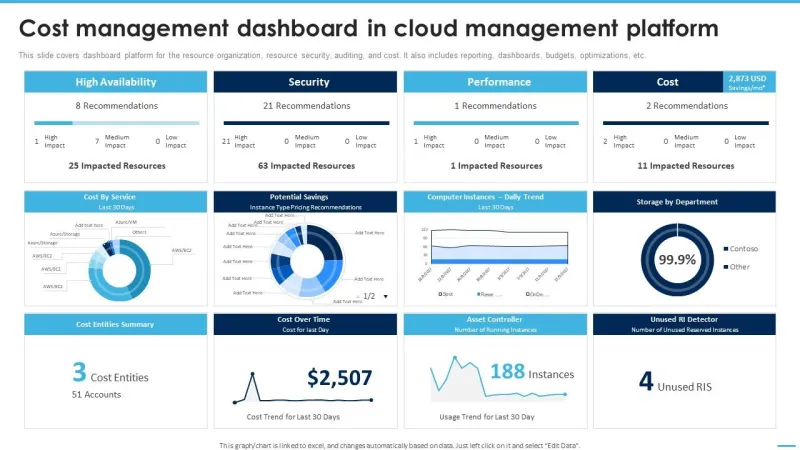
Photo: server infrastructure cloud computing cost analysis dashboard, via www.slidegeeks.com
The pitch for serverless computing is compelling on paper. No servers to provision, no idle capacity to pay for, and automatic scaling that adjusts to demand in real time. For startups and lean engineering teams across the United States, the appeal is obvious. Why manage infrastructure when a cloud provider will handle it for a fraction of the apparent cost?
The problem surfaces later — usually around the third month of production traffic, when the billing dashboard tells a story that no architect anticipated. Serverless is not inherently expensive. But it is exceptionally easy to make expensive, and the line between cost-efficient and catastrophically overpriced is thinner than most technical decision-makers realize.
What the Marketing Materials Leave Out
Cloud providers present serverless pricing through a best-case lens: pay only for the milliseconds your function runs, and nothing more. That framing obscures several cost vectors that compound quickly under real-world conditions.
Function invocations are charged per execution, and high-traffic applications can generate tens of millions of calls per day. At first glance, the per-invocation rate looks negligible. Multiplied across an event-driven architecture with dozens of chained functions, that rate becomes a meaningful line item.
Cold starts introduce both a latency penalty and an indirect cost. When a function has been idle and must initialize from scratch, execution time increases — sometimes dramatically. For applications where functions are billed by duration, cold starts extend every affected invocation's billable window. For user-facing workloads, they also degrade the experience in ways that erode conversion rates and customer retention.
Data transfer and egress fees represent the most frequently underestimated expense in serverless deployments. Every time a function retrieves data from a database, communicates with an external API, or returns a response to a client, data moves across network boundaries. Cloud providers charge for that movement, and those charges accumulate with remarkable speed in data-intensive applications.
A Scenario Most Teams Recognize Too Late
Consider a mid-sized e-commerce company that migrates its order processing pipeline to a serverless model. The architecture looks elegant: individual functions handle inventory checks, payment processing, notification dispatch, and fulfillment routing. Each function is small, modular, and independently scalable.
During peak periods — holiday sales, promotional events — the system scales without intervention. The engineering team celebrates. Then the invoice arrives.
The order pipeline triggers an average of fourteen function invocations per transaction. Each invocation pulls configuration data from a managed database and writes logs to a centralized storage service. During a single promotional weekend generating 80,000 orders, the system executes over one million function calls, transfers several terabytes of data internally, and incurs cold-start penalties on functions that sat idle between traffic bursts.
The bill for that weekend exceeds what the company paid in an entire month on its previous dedicated hosting arrangement. The architecture was technically sound. The economics were not.
When Serverless Genuinely Delivers Value
This is not an argument against serverless computing. It is an argument for applying it deliberately.
Serverless excels in specific scenarios. Workloads with highly irregular traffic patterns — systems that process thousands of requests for two hours per day and sit dormant for the remaining twenty-two — benefit enormously from pay-per-invocation pricing. Background jobs, webhook processors, scheduled tasks, and event-driven pipelines with modest data movement are natural fits.
Applications where engineering velocity matters more than infrastructure optimization also benefit. Early-stage products that need to ship quickly and cannot justify dedicated operations resources can absorb higher per-unit costs in exchange for reduced operational overhead. The math changes as those products scale.
The inflection point — where serverless costs begin to exceed equivalent traditional or containerized hosting — typically arrives when an application sustains consistent, predictable traffic. At that point, the dynamic pricing model that made serverless attractive becomes a liability. Reserved capacity on a well-configured hosting platform almost always costs less than continuous high-volume serverless execution.
The Framework for an Honest Evaluation
Before committing to a serverless architecture, or before deciding to migrate away from one, a structured cost analysis is essential. That analysis should account for more than the obvious invocation and compute charges.
Map every data movement. Identify every point where your functions read from or write to external services, databases, or storage systems. Estimate the volume of data transferred per invocation and per day. Apply your provider's egress rates to those estimates before finalizing any architectural decision.
Model your traffic realistically. Serverless cost calculators produce accurate results only when fed accurate inputs. Use actual traffic data — not projected growth scenarios — to model current costs. Then apply growth projections separately to understand how costs scale.
Account for cold start frequency. If your application serves latency-sensitive users, calculate how often functions will experience cold starts based on your traffic patterns. Factor both the duration penalty and the user experience impact into your evaluation.
Compare against a properly sized alternative. The comparison should not be serverless versus an over-provisioned dedicated server. It should be serverless versus a right-sized, auto-scaling container or virtual machine configuration on a reliable hosting platform. That comparison often reveals a narrower cost advantage for serverless than the initial estimates suggest.
Rearchitecting Without Starting Over
For teams already operating serverless workloads that have grown more expensive than anticipated, a full migration is rarely necessary. Targeted optimizations frequently recover a significant portion of excess spend.
Consolidating fine-grained functions into coarser units reduces invocation counts without sacrificing the modular architecture. Implementing connection pooling at the database layer reduces per-invocation data retrieval overhead. Caching configuration and reference data in memory eliminates repeated external calls. Warming strategies — keeping critical functions active during predictable traffic windows — reduce cold start frequency.
For the portions of an application that run continuously and predictably, migrating those specific components to containerized or traditional hosting while retaining serverless for genuinely event-driven workloads often produces the optimal cost profile.
Building Infrastructure That Serves the Business
The infrastructure decisions that serve a business best are rarely the ones that follow industry trends most closely. They are the ones grounded in an honest assessment of workload characteristics, traffic patterns, and total cost of ownership.
Serverless computing is a powerful tool. Like any tool, its value depends entirely on whether it is matched to the job at hand. Organizations that evaluate it rigorously — accounting for every cost dimension before committing, and revisiting that evaluation as their applications evolve — will extract genuine value from the model.
Those that adopt it because it sounds modern, or because a vendor's introductory pricing made the first few months look inexpensive, often find themselves managing an infrastructure cost problem that grows harder to reverse with every passing quarter.
The web services infrastructure that powers a successful online business is not defined by which technology is newest. It is defined by which configuration reliably serves users at a cost the business can sustain. That standard should guide every architectural decision, serverless or otherwise.